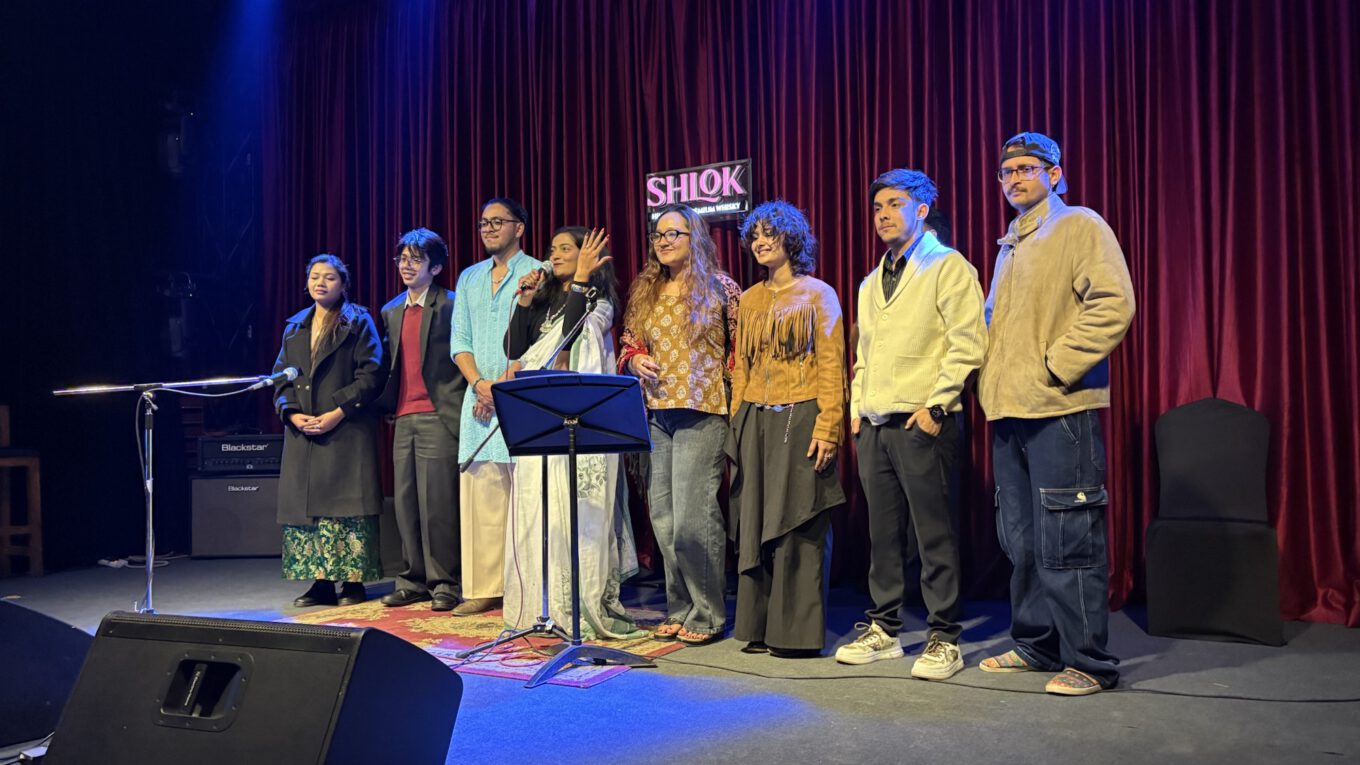
World Poetry Day in Kathmandu – und was danach in mir blieb
Ich war am vergangenen Samstag beim World Poetry Day in Kathmandu.
Ich habe wenig verstanden – und viel begriffen.
Die meisten Texte wurden auf Nepali vorgetragen. Während der Veranstaltung blieb mir der Zugang über Worte weitgehend verschlossen. Ich hörte Stimmen. Ich sah Gesichter. Ich spürte Pausen. Mehr nicht.
Und doch war da etwas.
Erst in den Tagen danach begann ich, die Texte zu transkribieren und zu übersetzen. Langsam. Zeile für Zeile. Manchmal eher erratend als wissend. Und erst da wurde mir klar, was ich eigentlich gehört hatte.
Nicht einzelne Gedichte.
Sondern Variationen eines Themas.
Liebe, die bleibt
Fast alle Texte kreisten um Liebe. Aber nicht um die erfüllte, nicht um die einfache.
Sondern um die, die bleibt, obwohl alles andere gegangen ist.
„Was uns verbunden hat,
ist nicht mehr da.
Und doch ist da noch Liebe.“
Das hat mich beschäftigt. Diese Selbstverständlichkeit, mit der Liebe nicht an Beziehung gebunden ist. Sie verschwindet nicht automatisch, nur weil zwei Menschen getrennte Wege gehen.
Sie verändert ihren Ort.
Sie zieht nach innen.
Und bleibt dort – manchmal sehr lange.
Erinnerung als Raum
Immer wieder tauchten Bilder auf: eine Gasse, ein Name, ein Passfoto, ein Tagebuch.
Kleine Dinge. Und doch tragen sie ganze Welten.
„Wenn ich irgendwo ihren Namen lese,
bleibt mein Herz einen Moment stehen.“
Ich habe das verstanden. Nicht intellektuell. Körperlich.
Erinnerung ist kein Gedanke. Sie ist ein Ort. Man geht ihn entlang wie eine Straße. Man betritt ihn wie ein Haus. Und manchmal kommt man nicht wieder heraus.
Zeit als leiser Gegner
Was mich überrascht hat: In vielen Texten war nicht nur die Trennung das Problem. Sondern die Zeit.
Nicht gleichzeitig. Nicht im richtigen Moment. Nicht in derselben Reife.
„Vielleicht war etwas da –
nur nicht zur selben Zeit.“
Das ist eine andere Art von Tragik. Leiser. Schwerer zu greifen. Und vielleicht näher an der Wirklichkeit, als wir zugeben möchten.
Die Mutter
Ein Text hat mich besonders berührt. Er handelte von der Mutter.
Nicht als Anklage. Nicht als Ideal. Sondern als Spiegel.
„Ich habe Angst:
Ich werde wie meine Mutter.“
Das war kein einfacher Satz. In ihm lag Bewunderung – und zugleich Widerstand.
Die Stärke der Mutter. Ihre Fähigkeit zu tragen, auszuhalten, zu lieben.
Und gleichzeitig die Frage:
Wie lebt man ein eigenes Leben, ohne genau dieses Muster zu wiederholen?
Ein eigenes Haus
Vielleicht das klarste Bild des Abends:
„Ein Haus, das mir gehört.
Nicht dem Vater.
Nicht dem Mann.
Nicht dem Bruder.“
Das ist kein architektonischer Wunsch. Das ist ein existenzieller Satz.
Ein Haus bedeutet hier: Ich entscheide. Ich gestalte. Ich bleibe.
Ich bin nicht nur Teil eines Systems. Ich bin Ursprung.
Ich habe selten so präzise gehört, wie sich Selbstbestimmung anfühlen kann.
Was bleibt
Ich bin aus diesem Abend herausgegangen, ohne viel verstanden zu haben.
Und ich habe ihn Tage später neu betreten – beim Übersetzen.
Vielleicht ist das das eigentliche Geschenk von Poesie:
Dass sie sich nicht sofort erschließt.
Dass sie bleibt.
Dass sie arbeitet.
„Liebe geht nie verloren.
Sie kommt zu dir zurück – vielfach.“
Ich weiß nicht, ob das stimmt.
Aber ich habe an diesem Abend verstanden, warum Menschen es sagen.
Und vielleicht reicht das.
English version below
World Poetry Day in Kathmandu – and What Stayed With Me
I attended the World Poetry Day event in Kathmandu last Saturday.
I understood very little – and yet I grasped a lot.
Most of the texts were performed in Nepali. During the event, words were largely closed to me. I listened to voices. I watched faces. I felt pauses. That was all.
And yet, something remained.
In the days that followed, I began to transcribe and translate the texts. Slowly. Line by line. Sometimes guessing more than knowing. And only then did I realize what I had actually heard.
Not individual poems.
But variations of a single theme.
Love that remains
Almost all texts revolved around love. But not fulfilled love. Not easy love.
Rather, a love that remains even after everything else has gone.
“What connected us
is no longer there.
And yet, love remains.”
This stayed with me. The quiet certainty that love is not bound to a relationship. It does not disappear simply because two people part ways.
It changes its place.
It moves inward.
And it stays there – sometimes for a very long time.
Memory as a place
Again and again, certain images appeared: an alley, a name, a photograph, a diary.
Small things. And yet they carry entire worlds.
“When I see her name somewhere,
my heart stops for a moment.”
I understood that. Not intellectually. Physically.
Memory is not a thought. It is a place. You walk through it like a street. You enter it like a house. And sometimes, you don’t come back out.
Time as a silent opponent
What surprised me: in many texts, the problem was not only separation. It was time.
Not at the same moment. Not in the same maturity. Not in the right phase of life.
“Perhaps something was there –
just not at the same time.”
This is a different kind of tragedy. Quieter. Harder to grasp. And perhaps closer to reality than we would like to admit.
The mother
One text touched me deeply. It was about the mother.
Not as accusation. Not as ideal. But as a mirror.
“I am afraid:
I will become my mother.”
There was admiration in that sentence – and resistance.
The strength of the mother. Her ability to carry, to endure, to love.
And at the same time the question:
How do you live your own life without repeating hers?
A house of one’s own
Perhaps the clearest image of the evening:
“A house that belongs to me.
Not to my father.
Not to my husband.
Not to my brother.”
This is not about architecture. It is existential.
A house here means: I decide. I shape. I remain.
I am not merely part of a system. I am its origin.
I rarely hear self-determination expressed so clearly.
What remains
I left that evening without understanding much.
And I returned to it days later – through translation.
Perhaps this is what poetry does best:
It does not reveal itself immediately.
It stays.
It works within you.
“Love never goes to waste.
It comes back to you tenfold.”
I don’t know if that is true.
But I understand why people say it.
And perhaps that is enough.