Erst die Butterlampe. Dann die Frage.
Seit einer Woche bin ich in Nepal.
Seit einer Woche wache ich morgens um sechs Uhr auf – nicht vom Wecker, sondern vom Klang der Glocken des Hindu-Tempels auf der anderen Straßenseite. Kurz darauf setzen die Gesänge ein. Ruhig, gleichmäßig, ohne Eile.
Um sieben Uhr übernehmen die Vögel. Jeden Morgen zur gleichen Zeit versammeln sie sich auf der Wäscheleine auf dem Nachbardach. Ein kräftiger Chor. Kein Zufall. Ein Ritual.
Um zwölf Uhr wieder Glocken. Wieder Gesang.
Am Abend noch einmal.
Der Tag hat hier einen Rhythmus. Er wird nicht geplant. Er geschieht.
Am Vormittag kommt Aasha zu Besuch.
Aasha ist 21. Sie ist die Tochter des Vermieters des Zimmers, in dem Hishsi die letzten sechs Monate gelebt hat. Aasha vermietet selbst ein Zimmer an Gäste aus Westeuropa und Nordamerika. Menschen, die nach Nepal kommen, um zu meditieren, Yoga zu üben – oder beides.
Aasha ist lizenzierte Tourguide. Sie ist an der Universität ausgebildete Yoga-Lehrerin. Sie spricht gutes Englisch. Sie will Deutsch lernen. Vor Kurzem war sie einen Monat auf den Philippinen. Dort nahm sie an einem zehntägigen Vipassana-Retreat teil. Schweigen. Meditation. Kein Handy. Keine Ablenkung.
Jetzt plant sie den nächsten Schritt.
Weitere Zimmer im Haus ihrer Eltern. Mehr Homestay. Mehr Gäste. Mehr Einkommen.
Und dann vielleicht: die Welt sehen.
Wir sitzen zusammen. Sie erzählt. Ich frage. Wir diskutieren.
Ich stelle ihr eine Frage, die mir seit Tagen durch den Kopf geht:
„Ist es nicht seltsam, dass Menschen aus den reichsten Ländern der Welt nach Nepal kommen, um hier zu meditieren? In eines der ärmsten Länder der Erde?“
Aasha denkt kurz nach. Dann lächelt sie.
„Vielleicht“, sagt sie, „suchen sie nichts Neues. Vielleicht suchen sie etwas sehr Altes.“
Das Bild ist seltsam.
Manager aus Deutschland, Lehrerinnen aus der Schweiz, Softwareentwickler aus Kalifornien sitzen im Schneidersitz vor Meditationslehrern, die weder Laptop noch WLAN brauchen. Sie reisen mit Flugticket, Yogamatte und Hoffnung. Sie verzichten freiwillig auf Komfort. Sie suchen Ruhe. Sinn. Ordnung.
Zuhause fehlt es an nichts.
Heizung. Krankenversicherung. Rente. Wahlmöglichkeiten. Vier Sorten Hafermilch. Sechs Streamingdienste. Freiheit im Übermaß.
Diese Freiheit kostet. Sie verlangt Entscheidungen. Jeden Tag.
Wer bin ich? Was will ich? Wofür stehe ich morgens auf?
Früher beantworteten das Religion, Familie, Dorf. Heute liegt die Antwort beim Einzelnen. Autonomie als Dauerzustand. Das erschöpft.
In Westeuropa und Nordamerika ist Spiritualität leise geworden. Man glaubt diskret oder gar nicht. Wer meditiert, tut es im Kurs. Wer betet, schließt die Tür. Die Kirche steht noch da – oft leer. Dafür sind die Wartezimmer voll.
Was früher Beichte war, ist heute Therapie.
Was früher Sünde hieß, heißt heute Trauma.
Das ist ein Fortschritt. Aber auch eine Verschiebung.
Es verlagert sich zum Individuum.
Du bist frei. Also bist du verantwortlich.
Für dein Glück. Für dein Scheitern. Für deine Sinnkrise.
Aasha hört zu. Sie nickt. Sie kennt diese Sprache.
Aber sie lebt in einer anderen Wirklichkeit.
In Nepal ist Spiritualität keine Debatte. Sie ist Praxis.
Am Morgen die Butterlampe. Vor der Reise ein Segen. Am Abend ein Räucherstäbchen. Die Götter stehen nicht im Weg. Sie stehen daneben. Manchmal mitten im Raum.
Das Leben ist härter. Unsicherer. Weniger planbar.
Aber es ist eingebettet.
Aasha steht zwischen diesen Welten.
Sie meditiert.
Und sie kalkuliert.
Sie kennt das Schweigen des Vipassana-Retreats.
Und sie kennt die Preise für Zement und Ziegel.
Sie ist voller Ideen.
Voller Energie.
Voller Fragen.
Voller Sorgen um ihre Eltern. Um das Haus. Um das Einkommen.
Voller Sorgen um sich. Um Freiheit. Um Zukunft. Um Zeit.
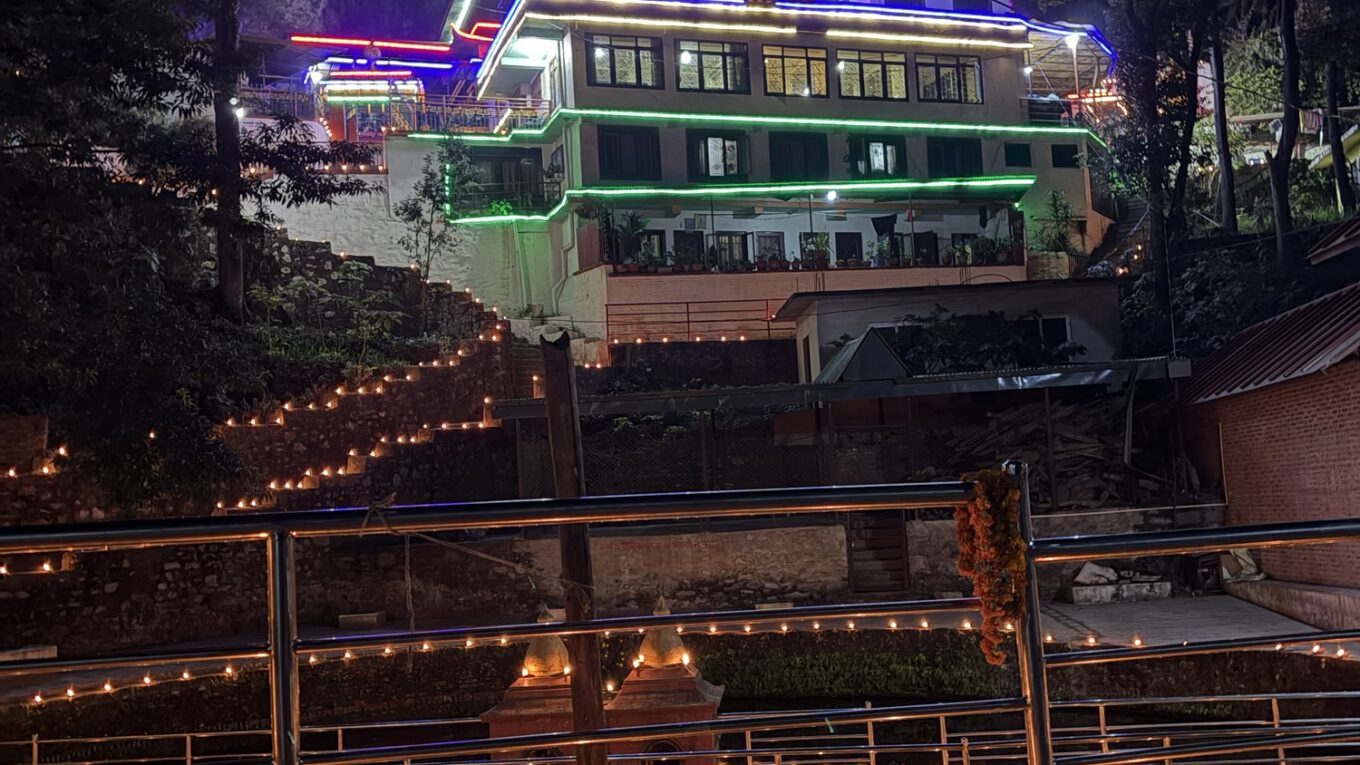
Am Abend fahren Hishsi und ich noch schnell einkaufen. Es ist bereits dunkel. Auf dem Rückweg kommen wir am Seshanarayan-Tempel vorbei. Die Wege sind gesäumt von unzähligen Butterlampen. Kleine Flammen, dicht an dicht. Kein Kommentar. Keine Erklärung.
Man muss diesen Anblick fühlen.
Verstehen wird man nichts.
Ich denke an Aasha. An ihre Pläne. An ihre Fragen. An ihre Ruhe und ihre Unruhe.
Und ich denke an die Menschen, die hierherkommen, um still zu werden.
Vielleicht ist das eigentliche Missverständnis, dass man glaubt, Spiritualität sei eine Antwort.
Dabei ist sie oft nur ein Rahmen.
Oder, wie Aasha es am Vormittag sagte, ganz beiläufig, fast nebenbei:
„Erst die Butterlampe. Dann die Frage.“
Heute Morgen weckten mich wieder die Glocken.
Ich stand auf, erhitzte Wasser für unseren Tee und Kaffee, entzündete ein Räucherstäbchen. Der Rauch füllte langsam das Haus. Ich setzte mich und schrieb. Als ich die Jalousien öffnete, lag der Urwald gegenüber still im ersten Licht des Morgenrots.
English version below
First the Butter Lamp. Then the Question.
I have been in Nepal for a week now.
For a week, I have been waking up at six in the morning—not to an alarm clock, but to the sound of bells from the Hindu temple across the street. Shortly afterward, the chanting begins. Calm, steady, unhurried.
At seven, the birds take over. Every morning at the same time, they gather on the clothesline on the neighboring rooftop. A powerful chorus. No coincidence. A ritual.
At noon, the bells return. The chanting again.
In the evening, once more.
The day has a rhythm here. It is not planned. It unfolds.
In the late morning, Aasha comes by.
Aasha is 21. She is the daughter of the landlord of the room where Hishsi lived for the past six months. Aasha herself rents out a room to visitors from Western Europe and North America—people who come to Nepal to meditate, practice yoga, or both.
Aasha is a licensed tour guide. She is a university-trained yoga teacher. She speaks good English. She wants to learn German. Recently, she spent a month in the Philippines, where she took part in a ten-day Vipassana retreat. Silence. Meditation. No phone. No distractions.
Now she is planning her next step.
More rooms in her parents’ house. A larger homestay. More guests. More income.
And then, perhaps: seeing the world.
We sit together. She talks. I ask questions. We discuss.
I put into words a thought that has been on my mind for days:
“Isn’t it strange that people from the richest countries in the world come to Nepal to meditate—one of the poorest countries on earth?”
Aasha pauses for a moment. Then she smiles.
“Maybe,” she says, “they’re not looking for something new. Maybe they’re looking for something very old.”
The image is strange.
Managers from Germany, teachers from Switzerland, software developers from California sit cross-legged in front of meditation teachers who need neither laptops nor Wi-Fi. They arrive with plane tickets, yoga mats, and hope. They willingly give up comfort. They are looking for calm. Meaning. Order.
Back home, nothing is missing.
Heating. Health insurance. Pensions. Endless choices. Four kinds of oat milk. Six streaming services. Freedom in excess.
This freedom comes at a price. It demands decisions. Every day.
Who am I? What do I want? Why do I get up in the morning?
Religion, family, and community once answered these questions. Today, the answers lie with the individual. Autonomy as a permanent state. It is exhausting.
In Western Europe and North America, spirituality has grown quiet. People believe discreetly—or not at all. Those who meditate do so in courses. Those who pray close the door. Churches are still standing—often empty. Meanwhile, waiting rooms are full.
What used to be confession is now therapy.
What used to be called sin is now called trauma.
This is progress. But it is also a shift.
The burden moves to the individual.
You are free. And therefore responsible.
For your happiness. For your failure. For your crisis of meaning.
Aasha listens. She nods. She knows this language.
But she lives in a different reality.
In Nepal, spirituality is not a debate. It is practice.
In the morning, the butter lamp. Before a journey, a blessing. In the evening, incense. The gods are not in the way. They stand beside you. Sometimes right in the middle of the room.
Life is harder here. More uncertain. Less predictable.
But it is embedded.
Aasha stands between these worlds.
She meditates.
And she calculates.
She knows the silence of the Vipassana retreat.
And she knows the price of cement and bricks.
She is full of ideas.
Full of energy.
Full of questions.
Full of concern for her parents. For the house. For the income.
Full of concern for herself. For freedom. For the future. For time.
In the evening, Hishsi and I drive out briefly to buy groceries. It is already dark. On the way back, we pass the Seshanarayan Temple. The paths are lined with countless butter lamps. Small flames, close together. No commentary. No explanation.
You have to feel this sight.
Understanding will get you nowhere.
I think of Aasha. Of her plans. Of her questions. Of her calm and her restlessness.
And I think of the people who come here to find stillness.
Perhaps the real misunderstanding is the belief that spirituality provides answers.
Often, it is only a framework.
Or, as Aasha said that morning, casually, almost in passing:
“First the butter lamp. Then the question.”
This morning, the bells woke me again.
I got up, heated water for our tea and coffee, lit an incense stick. The smoke slowly filled the house. I sat down and began to write. When I opened the blinds, the jungle across from us lay still in the first light of dawn.