Durch Samsara gehen
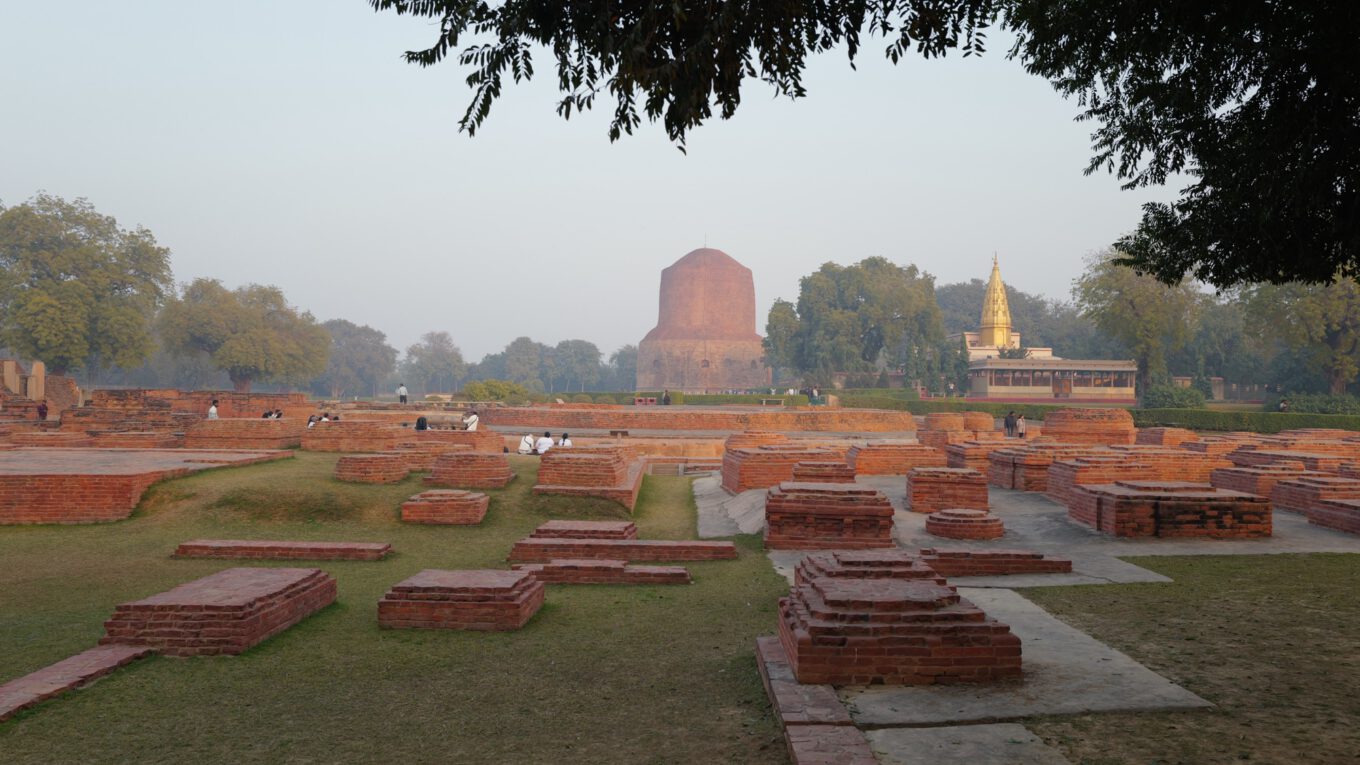
Seit gestern sind wir in Sarnath, nahe Varanasi. Wir besuchen Hishsi’s Vater, der hier seit sechs Jahren als Koch in einem buddhistischen Kloster arbeitet. Ein Leben zwischen frühen Morgenstunden, dampfenden Töpfen und festen Zeiten. Unspektakulär – und doch getragen von einer stillen Ordnung.
Am Morgen half Hishsi ihm in der Küche. Ich selbst kam, eher beiläufig, mit dem Klostervorsteher ins Gespräch. Er ist 35 Jahre alt. Wach, ruhig, ohne jede Pose. Er erzählte mir, dass alle fünfundzwanzig Mönche aus Nepal stammen. Die meisten sind Schüler oder Studenten. Sie leben hier nicht in Weltabkehr, sondern in einer doppelten Ausbildung: einer weltlichen und einer buddhistischen. Beides gehört zusammen.
Ich sprach ihn auf Ost und West an. Auf unseren ausgeprägten Individualismus, auf das westliche Selbstverständnis, zuerst Einzelner zu sein und erst danach Teil einer Familie. Ich erzählte von unseren sozialen Sicherungssystemen: Rentenversicherung, Krankenversicherung, Arbeitslosenversicherung. Von der Idee, Verantwortung an Institutionen zu delegieren und dadurch Sicherheit herzustellen.
Seine Augen begannen zu leuchten.
Er wünschte sich solche Systeme auch für den Osten.
Ich zögerte und antwortete dann: Ja, diese Systeme geben Sicherheit. Aber sie haben ihren Preis. Einsamkeit. Alte Menschen leben bei uns oft nicht mehr mit ihren Kindern. Sie gehen ins Altersheim.
Er hörte aufmerksam zu und sagte ruhig, das müsse nicht schlimm sein. Dort könnten alte Menschen neue Freunde finden. Und außerdem sei das nun einmal der Lauf der Dinge. Da müssten wir alle durch.
„Da“ – damit meinte er Samsara.
Vielleicht hilft hier eine kurze Einordnung. Nicht als Erklärung, sondern als Erinnerung.
Im buddhistischen Denken bezeichnet Samsara den Kreislauf des Werdens und Vergehens, des Leidens und der Wiederkehr. Karma ist dabei keine moralische Buchhaltung, sondern die Folgewirkung von Handlungen und Haltungen. Wiedergeburt ist kein Trostbild, sondern Konsequenz: Man kommt wieder, solange man gebunden bleibt. Nirvana schließlich ist kein Ort, sondern das Erlöschen dieser Bindung.
Ich kenne diese Struktur seit Jahrzehnten. Ich habe darüber gelesen, Vorträge gehört, Texte geschrieben. Sie war mir vertraut – aber sie blieb abstrakt. Erst in diesem Gespräch, in der Selbstverständlichkeit, mit der Samsara ausgesprochen wurde, hat etwas bei mir gefunkt. Nicht als Gedanke. Als Haltung.
Samsara ist kein Fehler im System.
Es ist das System.
Vielleicht erklärt das die Gelassenheit vieler Menschen hier. Trotz Armut, trotz Unsicherheit, trotz der Mühen des Alltags. Es ist keine Romantisierung des Leidens. Eher seine Anerkennung. Man muss da durch. Das ist keine Kapitulation, sondern eine nüchterne Einsicht.
Im Westen versuchen wir oft, Samsara zu korrigieren. Mit Übungen, Programmen, Methoden. Vieles davon ist hilfreich. Aber es bleibt an der Oberfläche, wenn die innere Haltung fehlt. Hier scheint etwas anderes wirksam zu sein: nicht das Wegmachen des Leidens, sondern die Art, ihm zu begegnen.
Nicht verbissen.
Nicht klagend.
Sondern ruhig, gütig, hilfsbereit.
Nicht, weil alles gut ist.
Sondern weil es nicht das Letzte ist.
Wir gehen durch Samsara.
Die Frage ist nicht, ob wir gehen.
Sondern wie.
English version below
Walking Through Samsara
Since yesterday we have been in Sarnath, near Varanasi. We are visiting Hishsi’s father, who has been working here as a cook in a Buddhist monastery for six years. A life shaped by early mornings, steaming pots, and fixed routines. Unspectacular — yet sustained by a quiet sense of order.
In the morning, Hishsi helped him in the kitchen. I, more or less by chance, found myself in conversation with the head of the monastery. He is 35 years old. Alert, calm, without any pose. He told me that all twenty-five monks come from Nepal. Most of them are pupils or students. They do not live here withdrawn from the world, but within a double education: a secular one and a Buddhist one. Both belong together.
I asked him about East and West. About our pronounced individualism, about the Western understanding of ourselves as individuals first and members of a family only second. I spoke about our social security systems: pensions, health insurance, unemployment insurance. About the idea of delegating responsibility to institutions in order to create security.
His eyes began to light up.
He wished for similar systems in the East.
I hesitated, then replied: yes, these systems do provide security. But they come at a price. Loneliness. Older people in our societies often no longer live with their children. They move into nursing homes.
He listened carefully and said calmly that this did not necessarily have to be a bad thing. There, older people might find new friends. And besides, that was simply the course of things. We all have to go through it.
“Through it” — by that he meant samsara.
A brief clarification may be helpful here — not as instruction, but as orientation.
In Buddhist thought, samsara refers to the cycle of becoming and passing away, of suffering and return. Karma is not a moral bookkeeping system, but the consequential effect of actions and inner attitudes. Rebirth is not a comforting image, but a logical result: one returns as long as one remains bound. Nirvana, finally, is not a place, but the extinguishing of that binding.
I have known this structure for decades. I have read about it, listened to lectures, written texts. It was familiar to me — yet it remained abstract. Only in this conversation, in the natural way samsara was spoken of, did something click. Not as a concept. As an attitude.
Samsara is not a flaw in the system.
It is the system.
Perhaps this explains the calmness visible in many faces here. Despite poverty, despite insecurity, despite the burdens of everyday life. This is not a romanticization of suffering. It is rather its acceptance. One has to go through it. That is not resignation, but sober insight.
In the West, we often try to fix samsara. With exercises, programs, methods. Much of this is helpful. But it remains superficial if the inner attitude is missing. Here, something else seems to be at work: not the elimination of suffering, but the way one meets it.
Not tense.
Not complaining.
But calm, kind, and helpful.
Not because everything is good.
But because it is not the final word.
We walk through samsara.
The question is not whether we walk.
But how.